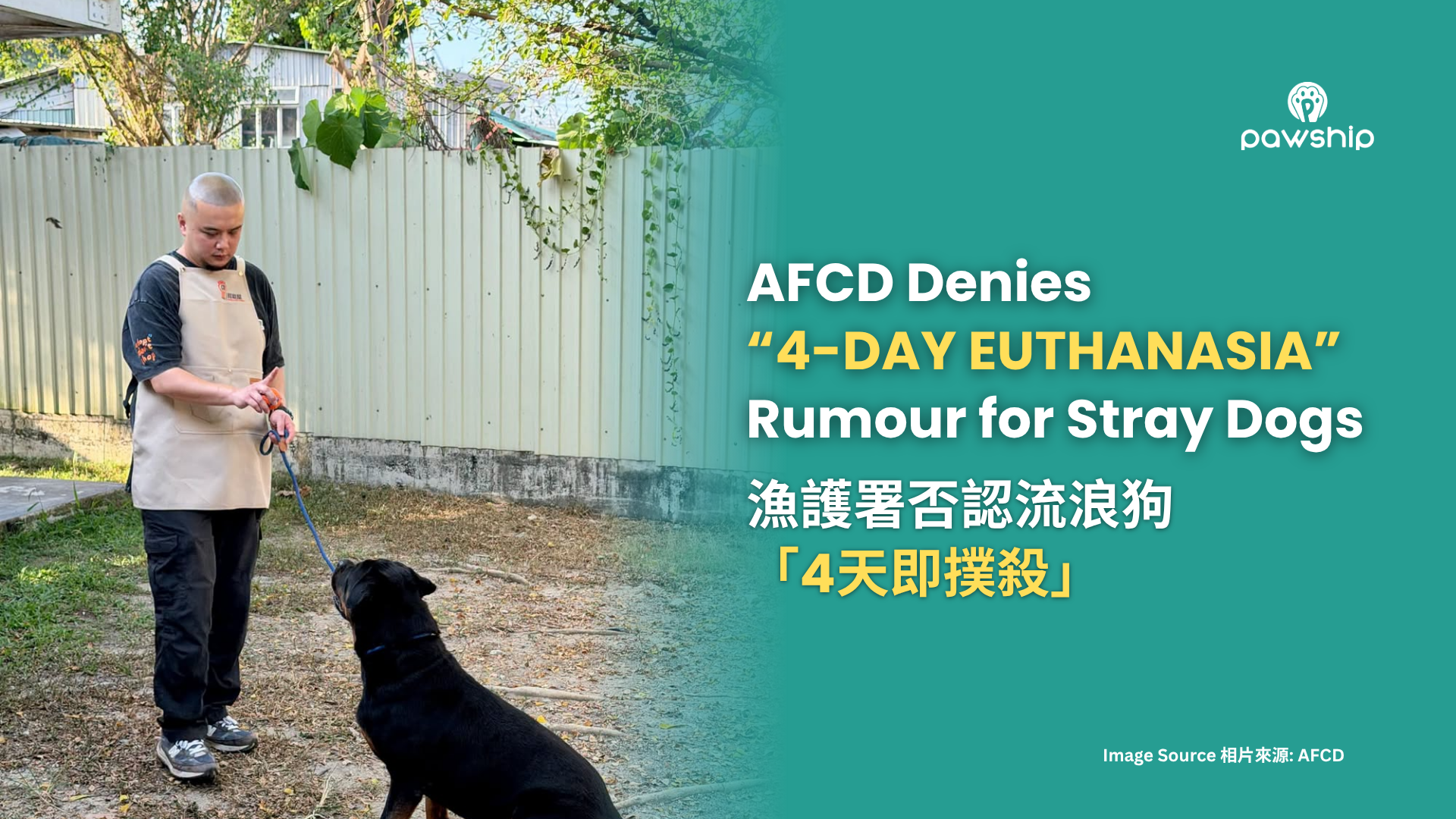
Recent dog attack incidents in Hong Kong have reignited public discussion about stray dog management, animal welfare, and sheltering policies. In response to widespread claims that stray dogs captured by the Agriculture, Fisheries and Conservation Department (AFCD) are automatically euthanised if unclaimed after four days, the department has clarified that the allegation is false.
According to the AFCD, the four-day period refers only to the minimum statutory detention period required under Hong Kong law and is not a deadline for euthanasia.
AFCD Clarifies: The 4-Day Detention Period Is Not a Euthanasia Deadline
AFCD Senior Veterinarian Dr. Wu Kai-hang explained that under Hong Kong’s Rabies Ordinance, stray dogs taken into custody must be held for a minimum of four days. If the owner cannot be identified or contacted during that period, the dog will remain at an Animal Management Centre for continued care, observation, and assessment.
Dr. Wu noted that the average observation period for animals received by AFCD currently exceeds 50 days, far longer than the legally required minimum detention period.
During their stay at the Animal Management Centre, stray dogs undergo veterinary examinations, vaccinations, medical treatment when necessary, behavioural assessments, and, in suitable cases, socialisation and adaptation training. These services are designed to support the dogs’ health and wellbeing while improving their prospects for adoption into permanent homes.
Euthanasia Considered a Last Resort
Addressing public concerns about animal euthanasia, Dr. Wu stressed that euthanasia is only considered as a last resort.
Even when a dog is initially assessed as unsuitable for adoption, AFCD will, where possible, allow more time for observation and arrange further evaluations rather than immediately proceeding with euthanasia.
Under current procedures, euthanasia may only be considered when an animal suffers from a severe, incurable illness with poor welfare prospects, consistently displays serious and unmanageable aggression, or poses an ongoing risk to public safety or other animals.
The department also confirmed that the 10 dogs captured in a recent incident in Yuen Long remain under observation and behavioural assessment. If they are deemed suitable, they may be transferred to animal welfare organisations for adoption arrangements.
AFCD Responds to Calls for a Trap-Neuter-Return (TNR) Programme
Animal welfare advocates have previously proposed implementing a Trap-Neuter-Return (TNR) programme for stray dogs in Hong Kong.
In response, AFCD stated that Hong Kong’s densely populated urban environment presents unique challenges and that releasing stray dogs back into the community could create potential public safety concerns. However, the department said it will continue exploring the feasibility of expanding animal sheltering and housing facilities as part of its long-term animal management strategy.
Animal Welfare Organisations Face Growing Capacity Challenges
One of AFCD’s partner animal welfare organisations, House of Joy & Mercy, currently operates three centres that provide temporary shelter for more than 300 animals.
Chan Wing-shun, the organisation’s event planner, described the shelters as transitional homes for rescued animals, with the goal of ensuring that every animal is cared for, receives medical treatment when needed, and ultimately finds a permanent home.
Despite ongoing adoption efforts, large and senior dogs continue to face significant adoption challenges.
According to House of Joy & Mercy, 43 dogs were successfully adopted last year. Of those 3 were large dogs, 9 were medium-sized dogs, and the remainder were primarily small dogs.
Because large dogs are generally more difficult to place with suitable families, shelter space dedicated to larger breeds remains under constant pressure.
To encourage adoption, the organisation’s Ko Po shelter is open to public visitors on weekdays and regularly hosts visits in partnership with schools and community groups.
The organisation has also called for increased government support and resources to help animal welfare groups expand adoption facilities and meet the growing demand for long-term animal care.