
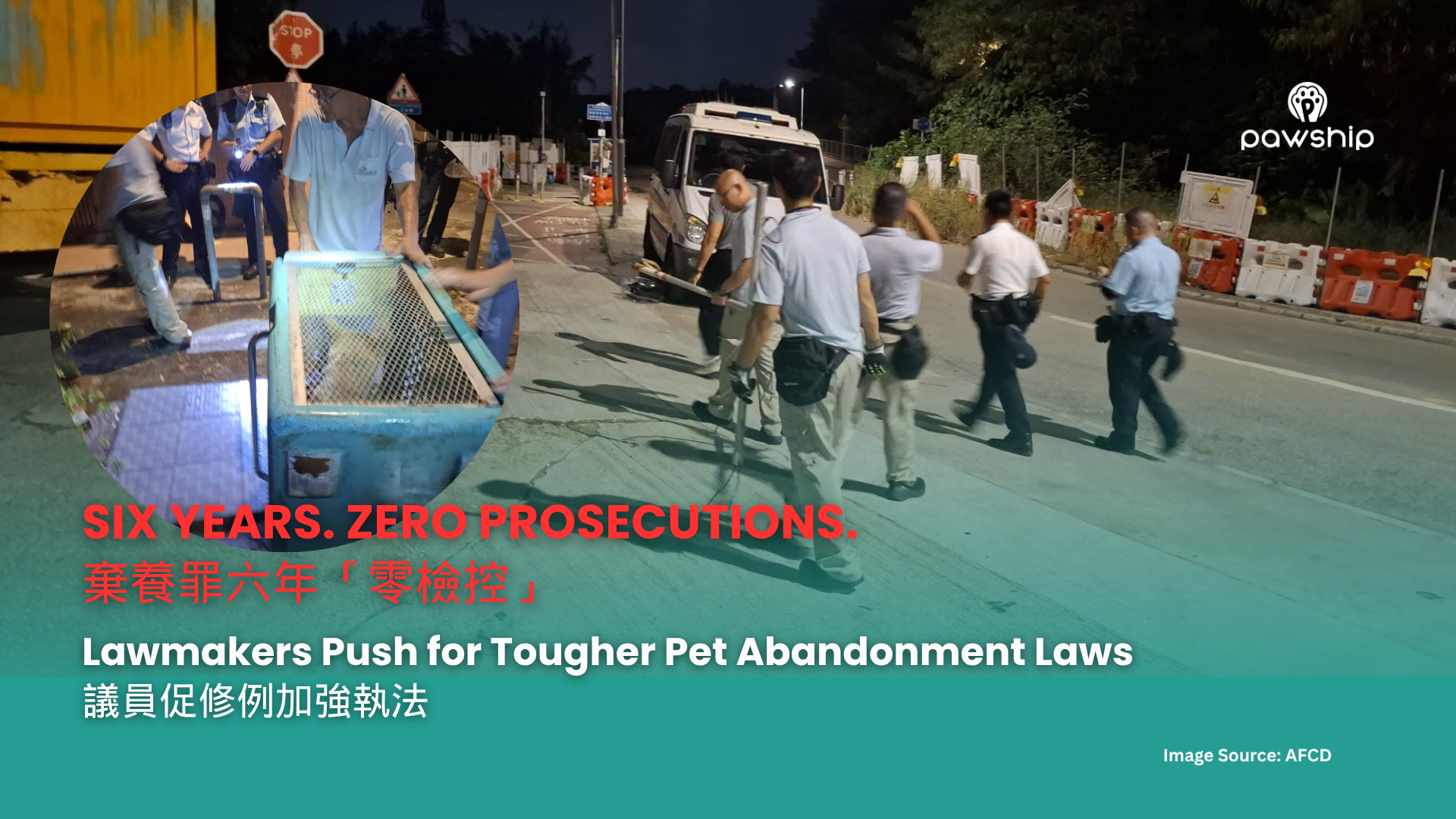
A recent fatal cycling incident involving a 27-year old woman, which is suspected to have involved a dog attack and remains under police investigation, has sparked widespread public concern.
Secretary for Environment and Ecology Tse Chin-wan said pet abandonment is one of the major causes of the stray animal problem and pledged to review existing legislation and consider increasing penalties. At the same time, official records show that no prosecutions were brought under Hong Kong’s pet abandonment offence between 2020 and 2025, prompting lawmakers to call for legal reform and stronger enforcement.
Evidence Challenges Leave Abandonment Law with Zero Prosecutions in Six Years
Under Section 22 of Hong Kong’s Rabies Ordinance, anyone who abandons an animal without a reasonable excuse is liable to a maximum penalty of a HK$10,000 fine and six months’ imprisonment.
However, records from the Agriculture, Fisheries and Conservation Department (AFCD) show no prosecutions were initiated under the provision from 2023 to 2025. Historical records also show no such prosecutions between 2020 and 2022, meaning the offence has recorded zero prosecutions over the past six years.
The AFCD acknowledged that gathering sufficient evidence to meet the legal threshold for abandonment can be challenging. In cases involving dog attacks, authorities more commonly prosecute under Section 23 of the Rabies Ordinance or the Dangerous Dogs Regulation, which target owners who fail to properly control their dogs in public places.
These offences carry a maximum fine of HK$10,000. For large dogs weighing 20kg or more, the maximum penalty is a HK$25,000 fine and three months’ imprisonment. Over the past three years, related prosecutions have averaged about 200 cases annually.
High Barrier to Proving Lack of a “Reasonable Excuse”
Rebecca Chan Hoi-yan, chair of the Legislative Council’s Panel on Food Safety and Environmental Hygiene, said proving that an owner lacks a “reasonable excuse” under the current law is particularly difficult. She noted that some rural dog owners may argue their dogs are free-roaming, while those intending to abandon pets could claim that the animals slipped their leashes and went missing.
While welcoming the government’s consideration of tougher penalties, Chan said stronger punishment alone may not be sufficient. She suggested authorities should make greater use of surveillance technology to assist evidence-gathering and strengthen public education on responsible pet ownership.
Legal Sector: Existing Law Can Be Used, but Evidence Is Critical
Barrister and lawmaker Alex Fan Hoi-kit argued that despite enforcement challenges, prosecution under the existing abandonment offence is not impossible.
He said that where a genuinely lost pet is captured, owners should report the matter to the AFCD or police. Failure to do so within 96 hours could support an inference that the animal had been abandoned.
Fan emphasised that defendants cannot automatically avoid liability simply by claiming in court that their dog was lost. He argued that responsible owners would normally report a missing pet, and courts would not necessarily accept an owner’s explanation as a “reasonable excuse” without supporting evidence.
He called on authorities to enforce the law on a case-by-case basis and consider optimising relevant legal provisions to ensure more effective implementation.